What Water Heater Is Right for Your San Francisco Home?
Choosing a new water heater is not as simple as replacing the old unit with whatever is available at the supply house. San Francisco homes vary widely in age, plumbing layout, electrical capacity, gas service, available space, hot-water demand, and installation conditions. A water heater that works well in one property may be a poor fit for another. The best choice depends on how the home is used, how much hot water is needed, what utilities are available, whether recirculation is present, and whether the homeowner values lower upfront cost, higher efficiency, faster recovery, space savings, or long-term operating performance. At Steven Bailey Plumbing & Rooter, we install and service multiple types of water-heating systems throughout San Francisco and the surrounding Bay Area. If you are considering replacement, start with our main Water Heaters page or learn more about professional Water Heater Installation.
The Main Types of Water Heaters
Most San Francisco homeowners will be choosing among several primary categories:
- Conventional tank water heaters
- Tankless water heaters
- Heat pump water heaters
- Indirect water heaters
- Combi boilers
Each has advantages, limitations, and installation requirements. The right system should be selected based on the home rather than simply on brand, efficiency rating, or purchase price.
Conventional Tank Water Heaters
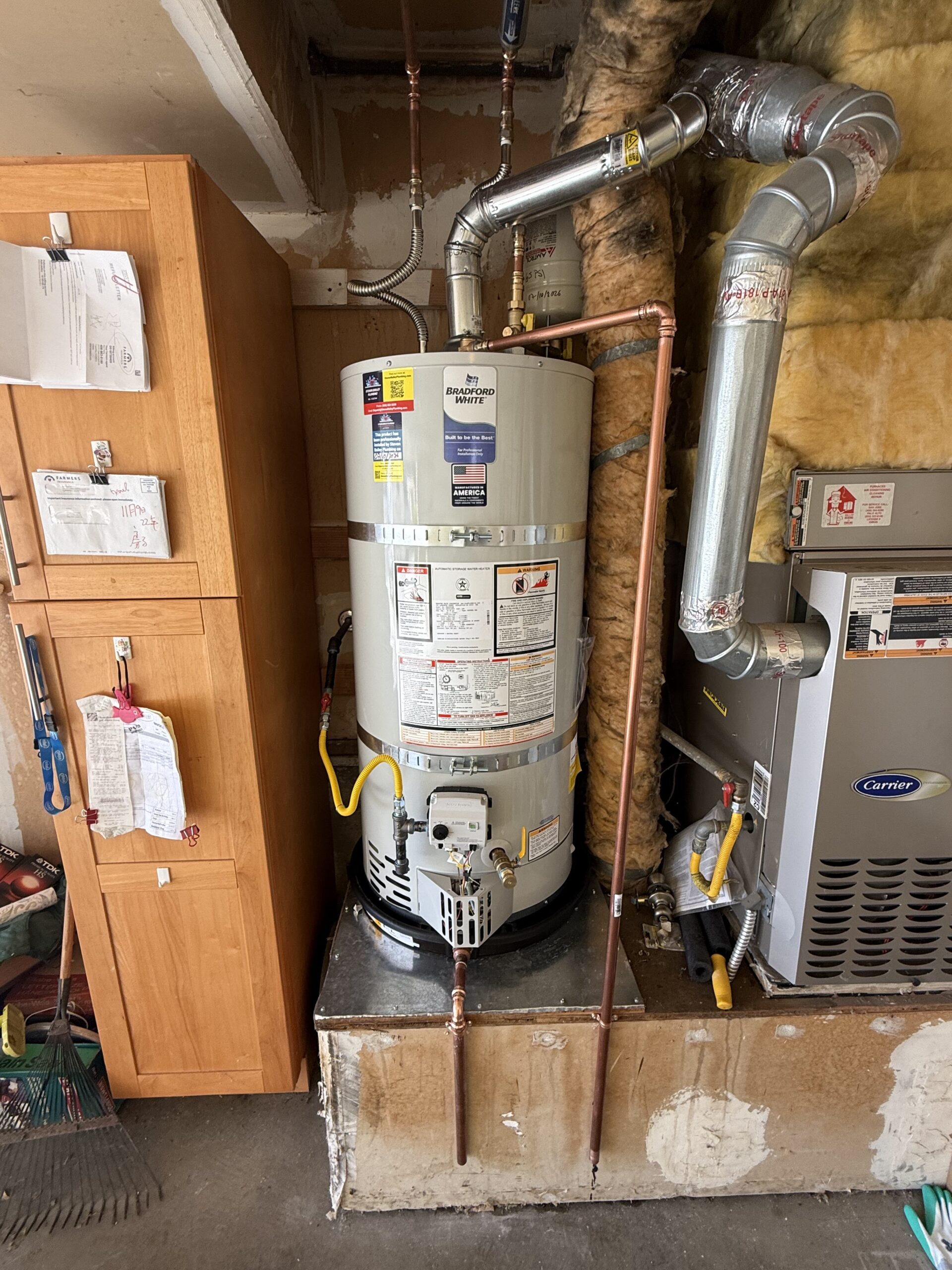
Traditional tank water heaters remain one of the most common options for residential properties. They store a fixed volume of heated water and maintain that water at a set temperature until it is needed. Common residential sizes include 40, 50, and 75 gallons, although the appropriate size depends on household demand and installation conditions. Tank water heaters are often attractive because they are familiar, relatively straightforward to service, and usually have a lower initial installation cost than more complex systems. For homeowners replacing an existing tank unit with a similar model, this can be the simplest path. However, a tank water heater does have limitations. Once the stored hot water is depleted, the homeowner must wait for the unit to recover. Larger households or homes with oversized tubs, multiple showers, or simultaneous fixture use may outpace a smaller tank.Tank systems also occupy more physical space than tankless units. If you are looking for a conventional replacement, our Water Heater Installation service covers proper sizing, connection, startup, and installation considerations.
Gas Tank Water Heaters
Gas-fired tank water heaters remain a practical choice in many San Francisco homes with existing natural gas service. They typically offer strong recovery performance and are well suited for homes where gas piping and venting are already properly configured. Before replacement, however, the surrounding installation should be evaluated. Important considerations include existing vent condition, combustion air, gas shutoff condition, gas connector sizing, water pressure, thermal expansion conditions, drain pan requirements, seismic restraint, temperature and pressure relief discharge piping, and accessibility for future service. A replacement water heater should not simply be installed into an unsafe or deteriorated existing configuration. The entire surrounding system should be evaluated before the new equipment is placed into service.
Electric Tank Water Heaters
Electric tank water heaters can be a good option where natural gas is unavailable or where the home already has adequate electrical capacity. They are mechanically simple and eliminate combustion venting requirements. The main limitation is electrical demand. A standard electric water heater requires a dedicated electrical circuit, and older San Francisco homes may not have sufficient panel capacity without upgrades. Operating cost also depends heavily on local electricity rates and usage patterns. For some properties, a standard electric tank makes sense. For others, a heat pump water heater may offer a more efficient electric alternative.
Tankless Water Heaters
Tankless water heaters heat water on demand rather than storing a large volume in a tank. They can be an excellent choice for homeowners who want space savings, long-duration hot water, higher efficiency, modern controls, and reduced standby heat loss. Tankless systems are especially attractive in homes where mechanical space is limited. However, they are not always a simple replacement for a tank water heater.
A proper tankless installation may require evaluation of:
- Gas line sizing
- Venting
- Combustion air
- Electrical power
- Condensate drainage
- Water hardness
- Recirculation design
- Maximum flow demand
- Fixture usage patterns
A tankless water heater must be sized for the expected simultaneous hot-water load, not simply selected by household size. If you are considering this option, visit our Tankless Water Heaters page.
Is Tankless Always Better?
No. Tankless systems offer several benefits, but they are not automatically the best choice for every home. A homeowner who rarely exceeds the capacity of a conventional tank may not gain enough practical benefit to justify the higher installation cost. Likewise, a home with undersized gas piping or difficult venting may require substantial additional work. Tankless systems also require periodic maintenance, especially in areas where mineral buildup can affect heat-exchanger performance. The correct question is not whether tankless is better in general. The correct question is whether it is better for the specific property.
Heat Pump Water Heaters
Heat pump water heaters are becoming increasingly important in California. Instead of generating heat directly through electric resistance elements alone, they move heat from the surrounding air into the stored water. This can make them significantly more efficient than standard electric resistance water heaters.
They can be a strong choice for homeowners who want:
- Reduced energy consumption
- Electrification
- High efficiency
- Compatibility with solar or cleaner electrical generation
- Potential access to rebate programs
Learn more about this technology on our Heat Pump Water Heaters page.
Heat Pump Water Heater Installation Considerations
Heat pump water heaters require more planning than many homeowners expect. Important factors include available electrical capacity, dedicated circuit requirements, installation space, air volume, condensate drainage, noise, ambient temperature, clearances, access for service, and recovery requirements. Because they pull heat from the surrounding air, they can cool and dehumidify the space where they are installed. That may be beneficial in some garages or utility rooms and undesirable in others.
For homeowners ready to move forward, we also offer professional Heat Pump Water Heater Installation.
Indirect Water Heaters
Indirect water heaters are commonly paired with hydronic boiler systems. Instead of using their own burner or primary electric heating element, they use hot boiler water passing through an internal heat exchanger to heat domestic water. They can be highly effective in homes that already have a properly designed boiler system. Advantages may include strong recovery, long service life, integration with an existing boiler, fewer combustion components at the tank, and good performance in larger homes. They are not appropriate for every property, but in homes with hydronic heating they can be an excellent solution.
Learn more about Indirect Water Heaters.
Combi Boilers: Domestic Hot Water and Space Heating in One System
A combination boiler, commonly called a combi boiler, combines two functions into one piece of equipment: it provides domestic hot water for plumbing fixtures while also supplying heated water for a hydronic space-heating system. Instead of having a separate boiler and conventional domestic water heater, a properly designed combi system can provide both services from a single appliance. This can be particularly attractive in San Francisco homes where mechanical-room space is limited or where an existing hydronic heating system is already part of the property. Unlike a conventional storage water heater, many combi boilers produce domestic hot water on demand. When a faucet or shower is opened, the appliance detects the domestic hot-water demand and temporarily prioritizes it. When the domestic demand ends, the boiler can return to serving the home’s hydronic heating zones.
Combi boilers can work with systems such as:
- Radiators
- Baseboard heating
- Hydronic radiant-floor heating
- Panel radiators
- Certain air handlers equipped with hydronic heating coils
Because one appliance is responsible for both space heating and domestic hot water, proper sizing is especially important. The equipment must be capable of satisfying the home’s heating load while also providing adequate domestic hot-water production. A combi boiler should therefore not be selected simply because its domestic hot-water flow rating sounds sufficient. The home’s heat loss, number of heating zones, emitter type, incoming water temperature, simultaneous hot-water demand, gas supply, venting, electrical requirements, condensate drainage, and control strategy all need to be considered.
When Does a Combi Boiler Make Sense?
A combi boiler may be worth considering when a home already has hydronic heating, needs both boiler and water-heating equipment replaced, has limited mechanical-room space, would benefit from eliminating a separate storage tank, has sufficient gas and electrical infrastructure, and has domestic hot-water demand that falls within the appliance’s capabilities. Combi boilers can provide a very clean mechanical installation when the system is designed correctly. They are not automatically the right choice for every hydronic home, however. A property with very high simultaneous domestic hot-water demand may be better served by a dedicated boiler and an indirect water heater. An indirect tank stores domestic hot water and can provide substantial recovery when paired with a properly sized boiler. This is why the decision between a combi boiler and a boiler with an indirect tank should be based on the home’s actual operating requirements rather than simply on which system uses less mechanical-room space.
Recirculation and Combi Boilers
Domestic hot-water recirculation also requires careful consideration with a combi boiler. A poorly designed recirculation system can cause unnecessary burner operation, excessive cycling, heat loss, or temperature-control problems. Check valves, pumps, controls, piping configuration, and manufacturer requirements all affect how the system performs. If the property has an existing recirculation system, or if faster hot-water delivery is an important goal, the recirculation design should be evaluated as part of the equipment selection process.
Learn more about Hot Water Recirculation.
Combi Boiler Maintenance
Like tankless water heaters, modern combi boilers contain heat exchangers, sensors, valves, pumps, controls, and other components that require periodic inspection and maintenance. Depending on the particular equipment and system, service may involve evaluating heat exchanger condition, combustion performance, hydronic system pressure, expansion tank condition, condensate drainage, circulators, zone valves, air elimination, domestic-water flow, filters and strainers, ignition components, venting, recirculation operation, and system controls. Because the appliance serves both domestic hot water and space heating, a failure can affect considerably more of the home than a conventional standalone water heater. Homeowners considering a combi boiler should therefore weigh not only installation cost and efficiency, but also maintenance expectations, equipment accessibility, parts availability, and long-term serviceability.
What About Water Heater Size?
Sizing should be based on actual hot-water demand. For tank systems, that means evaluating number of occupants, number of bathrooms, shower usage, bathtub size, laundry demand, dishwashing demand, simultaneous use, and recovery rate. A larger tank is not always better. An oversized system can cost more, occupy more space, and create unnecessary standby losses. An undersized system leads to poor hot-water availability. For tankless systems, sizing is based more heavily on flow rate and temperature rise. A home using two showers, a dishwasher, and a kitchen faucet at the same time requires a different tankless capacity than a smaller property with limited simultaneous demand.
How Recirculation Affects Water Heater Selection
Hot-water recirculation can significantly affect system design. A recirculation system keeps hot water moving through the building so fixtures receive hot water more quickly. This can improve convenience and reduce waiting time, but it also introduces additional system considerations. Poorly designed recirculation can cause excessive heat loss, increased energy consumption, temperature instability, cross-flow, short cycling, and unnecessary pump operation. Tankless systems and combi boilers are particularly sensitive to recirculation design.
If your home has or needs hot-water recirculation, visit our Hot Water Recirculation page.
Water Pressure Matters
Water pressure is often overlooked during water heater replacement. Excessive pressure can shorten the life of water-heating equipment and other plumbing components. If the home’s pressure-reducing valve is failing, a new water heater may be installed into the same condition that contributed to previous plumbing problems. Before replacing a water heater, it is often wise to verify static water pressure. If pressure is too high, the system may require a properly functioning pressure-reducing valve.
You can learn more about our Pressure Reducing Valve Installation and High Water Pressure services.
Thermal Expansion
Thermal expansion becomes important when the domestic water system is closed. As water heats, it expands. If a check valve, backflow device, pressure-reducing valve with check function, or other device prevents that expanded water from moving back toward the public supply, pressure can rise inside the home’s plumbing system. Where required by system configuration and applicable code, a properly sized thermal expansion tank or other approved expansion-control method may be necessary. The expansion tank should not simply be installed because one existed previously. The system should be evaluated to determine whether expansion control is actually required and whether the existing tank is functioning properly.
Gas Supply and Venting
When replacing a gas-fired water heater, the existing gas system should be evaluated rather than assumed to be adequate. Tankless systems and combi boilers can have significantly higher input ratings than standard tank water heaters. A gas line that was adequate for a conventional tank heater may not be appropriate for a high-input tankless or combi appliance.
Similarly, venting must be compatible with the specific appliance.
Different equipment may require:
- Category-specific vent materials
- Condensing vent systems
- Intake and exhaust piping
- Chimney evaluation
- Different termination requirements
Manufacturer instructions and applicable code govern the installation.
Electrical Capacity
Electric and heat pump water heaters can create significant electrical load. Before selecting the equipment, the home may need to be evaluated for panel capacity, breaker space, circuit size, disconnect requirements, and wiring condition. Older San Francisco homes often have electrical systems that were not designed around modern electrification loads. A water-heater replacement may therefore involve coordination with a qualified electrician.
Space and Access
Installation space can be a major factor in San Francisco homes. Mechanical equipment may be located in garages, closets, basements, crawl spaces, exterior utility areas, rooftop enclosures, or tight mechanical rooms. A replacement system must not only fit physically. It also needs adequate service clearance, ventilation where required, access, drainage, piping space, electrical access, and future maintenance access. The smallest appliance is not automatically the best appliance if it creates difficult or unsafe service conditions.
Water Heater Maintenance
Regardless of the type of water heater you choose, maintenance affects performance and service life.
Maintenance may include:
- Tank flushing
- Scale removal
- Anode inspection
- Pressure checks
- Relief-valve inspection
- Combustion inspection
- Condensate maintenance
- Filter cleaning
- Recirculation inspection
Tankless systems and combi boilers in particular should be maintained according to manufacturer recommendations.
Learn more about our Water Heater Maintenance services.
Repair or Replace?
Not every water-heater problem requires replacement. A system may still be repairable if the tank itself is intact and replacement parts are available. Common repairs may involve gas controls, ignition components, heating elements, thermostats, sensors, mixing valves, recirculation equipment, and piping connections. However, replacement may make more sense when the tank is leaking, equipment is severely corroded, repair costs are excessive, parts are no longer readily available, or the existing system no longer meets the household’s needs.
If the unit is still potentially repairable, visit our Water Heater Repair page.
Financing a Water Heater Replacement
Water-heater replacement can become a significant project, especially when code corrections, electrical upgrades, gas modifications, venting changes, or system conversion are involved. Steven Bailey Plumbing & Rooter offers financing options for qualifying projects.
You can learn more on our Financing page. Financing availability, terms, and approval are subject to the financing provider’s requirements.
So Which Water Heater Is Best?
There is no single water heater that is right for every San Francisco home. A conventional gas tank may be the most practical solution for a homeowner who wants straightforward replacement and predictable stored hot-water capacity. A tankless water heater may make more sense where space savings, efficiency, and long-duration hot-water production are priorities. A heat pump water heater may be attractive for a homeowner pursuing electrification and lower energy consumption. An indirect water heater can provide excellent performance when the property already has a properly designed hydronic boiler. A combi boiler may be appropriate when a homeowner wants to combine domestic hot-water production and hydronic space heating into one appliance. The correct system depends on the home’s hot-water demand, number of occupants and bathrooms, hydronic heating requirements, utility availability, gas capacity, electrical capacity, venting, available mechanical space, recirculation system, incoming water temperature, existing piping, budget, maintenance expectations, and long-term plans for the property. The goal should not be to install the newest or most complicated equipment available. The goal is to install the system that best matches the building.
Professional Water Heater Installation in San Francisco
Steven Bailey Plumbing & Rooter installs and services water heaters throughout San Francisco and the surrounding Bay Area. We can evaluate the existing system, review your hot-water needs, explain available options, and recommend equipment based on the actual property rather than simply replacing what is already there. Whether you are considering a conventional tank, tankless water heater, heat pump water heater, indirect water heater, or combi boiler, professional evaluation can help avoid installation problems and ensure the new system is properly matched to the home.
Visit our Water Heaters page to learn more.
Need Help Choosing the Right Water Heater?
There are more water-heating options available today than ever before, but the additional choices also make proper equipment selection more important. Steven Bailey Plumbing & Rooter can evaluate your existing water heater, plumbing configuration, gas or electrical service, hot-water demand, available space, recirculation system, and long-term goals before recommending a replacement. Whether you are considering a conventional tank, tankless water heater, heat pump water heater, indirect water heater, or combi boiler, we can help determine which system makes sense for your San Francisco home.