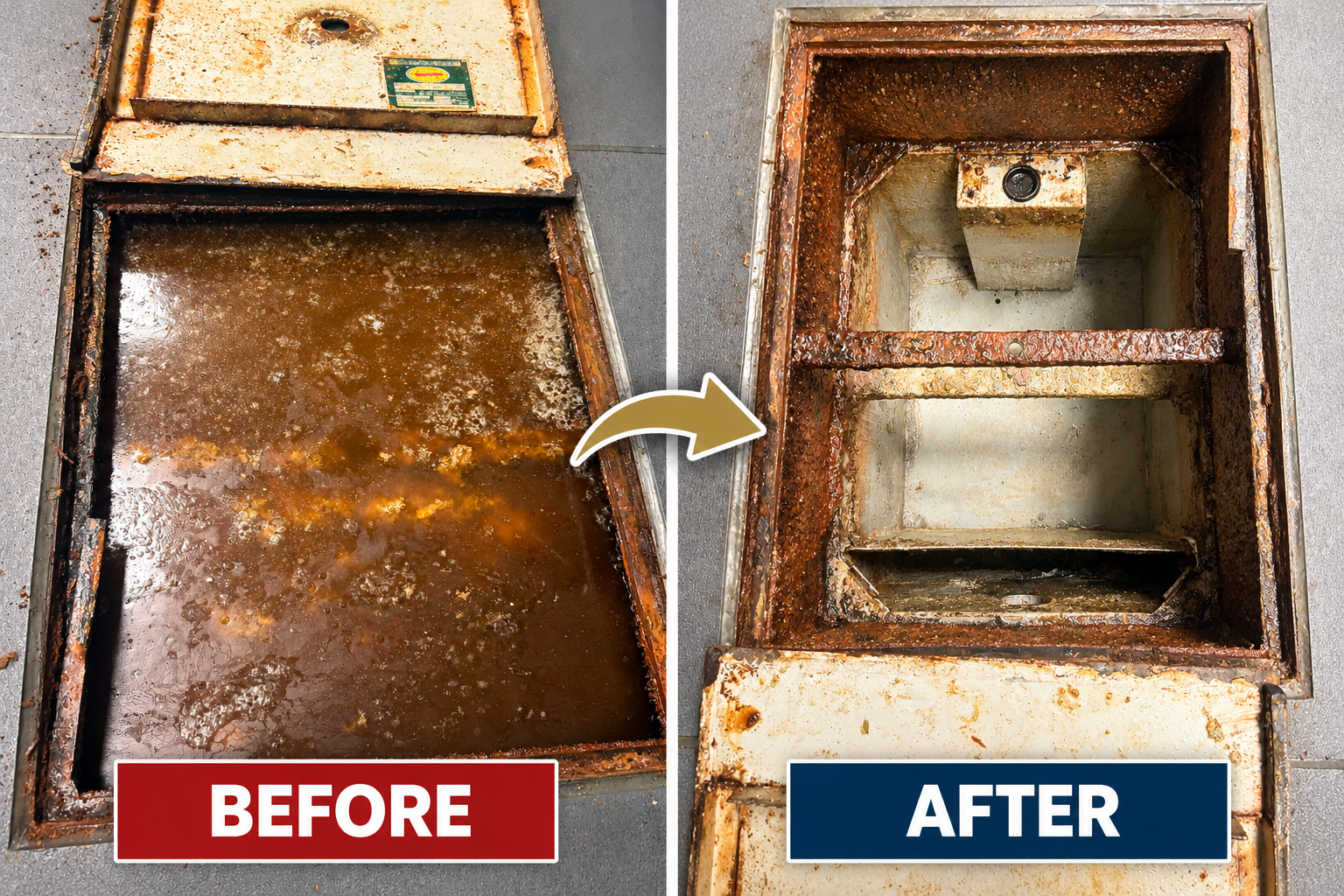
In a busy commercial kitchen, a clogged grease trap can bring operations to a standstill. Dishwashing sinks stop draining, wastewater rises into floor drains, and unpleasant odors begin spreading through food preparation areas. What initially appears to be a minor drainage problem can quickly interfere with sanitation, employee safety, and the restaurant’s ability to continue serving customers.
At Steven Bailey Plumbing & Rooter, we provide professional restaurant drain cleaning, grease trap troubleshooting, and mechanical drain snaking for food service establishments throughout San Francisco, San Mateo County, and Marin County. Our approach focuses on identifying the actual source of a blockage, restoring proper drainage, and helping restaurant operators understand what caused the problem in the first place.
Why Restaurant Grease Traps Become Clogged
Grease traps and grease interceptors are designed to separate fats, oils, and grease (FOG) from wastewater before it enters the building’s drainage system and municipal sewer. As wastewater passes through the interceptor, grease rises toward the surface while heavier solids settle toward the bottom. The remaining wastewater exits through the outlet and continues downstream. Over time, retained grease and settled food solids reduce the interceptor’s available capacity. When maintenance is neglected, grease can accumulate around inlet and outlet openings, obstruct internal flow paths, or escape into downstream drainage piping. Even a properly maintained interceptor may experience a blockage when excessive food debris, hardened grease, or other foreign material becomes lodged in its connected drain lines. Restaurant plumbing operates under demanding conditions. Dishwashers, compartment sinks, prep sinks, and floor drains may discharge repeatedly throughout the day. The combination of food particles, detergent, temperature changes, and heavy water usage can contribute to recurring restrictions. Once a partial blockage develops, wastewater may begin draining slowly before eventually backing up into the kitchen.
Snaking a Clogged Grease Trap Drain Line
Mechanical drain snaking is one method used to clear obstructions in the piping connected to a grease trap. A professional drain-cleaning machine uses a rotating cable and appropriately selected cutting or retrieval attachment to break through or remove certain obstructions. The correct equipment and access point depend on the pipe’s diameter, material, condition, configuration, and the location of the stoppage. Before attempting to clear the line, it is important to determine whether the restriction is located upstream of the interceptor, within the interceptor itself, or downstream in the outlet piping. These are different problems and may require different solutions. For example, a backed-up compartment sink with an otherwise functioning interceptor may indicate an obstruction in the incoming branch line. Conversely, an interceptor with an elevated liquid level and poor discharge may point toward a restricted outlet or downstream building drain. Where mechanical snaking is appropriate, the objective is to restore a clear drainage path without damaging the existing piping or internal interceptor components. Grease traps contain baffles, flow-control arrangements, and inlet and outlet fittings that should not be subjected to indiscriminate cable operation. Following removal of the obstruction, the drainage system should be tested under flowing-water conditions to evaluate whether normal discharge has been restored.
Grease Trap Cleaning Versus Drain Snaking: Understanding the Difference
One of the most important distinctions for restaurant operators is that clearing a clogged drain line does not necessarily mean the grease trap has been cleaned. Mechanical snaking addresses a restriction in piping, while grease trap cleaning involves removing accumulated grease, settled solids, and other retained waste from the interceptor. If the grease trap is filled with accumulated material, snaking its inlet or outlet may temporarily improve drainage without addressing the underlying maintenance problem. The retained waste still occupies valuable separation capacity and may contribute to additional stoppages. Likewise, pumping an interceptor will not automatically remove hardened grease deposits or foreign objects lodged farther down the building drain. Proper maintenance may therefore involve more than one service. A licensed plumbing contractor can diagnose and clear accessible drain-line obstructions, inspect relevant piping and fittings, and identify conditions requiring repair. Pumping and disposal of grease-interceptor waste should be performed by an appropriately equipped waste-hauling or grease-interceptor service provider in accordance with applicable local requirements. When both services are necessary, coordinating them helps address the immediate backup and the accumulated waste contributing to it.
Warning Signs of a Developing Grease Trap Blockage
Grease-related drainage problems often provide warning signs before a complete stoppage occurs. Restaurant employees may notice that a three-compartment sink takes longer than usual to empty, a nearby floor drain gurgles during dishwashing, or wastewater rises unexpectedly when several fixtures are used at once. Persistent odors around the interceptor or repeated backups following previous drain cleaning also deserve attention. These symptoms should not automatically be attributed to the grease trap. An obstructed branch drain, deteriorated cast-iron piping, improperly configured drainage, or a downstream sewer restriction can produce similar conditions. A careful diagnosis helps distinguish a localized kitchen drain problem from a broader building drainage failure. When wastewater begins overflowing onto a kitchen floor or into food preparation areas, the situation should be treated as urgent. Stop using affected fixtures, keep personnel away from contaminated areas, and arrange professional assistance. Our emergency plumbing services page explains how we approach urgent backups and other serious plumbing failures, subject to current service availability.
Why Restaurant Drain Blockages Keep Coming Back
Repeated snaking is not always a long-term solution. If the same kitchen drain becomes clogged every few weeks or months, there may be an underlying condition that mechanical cleaning alone cannot correct. Grease deposits can remain adhered to pipe walls after a cable opens a passage through the obstruction. Aging piping may also have internal corrosion, rough surfaces, poor slope, or damaged joints that encourage additional accumulation. Depending on the installation, a more thorough investigation may include checking accessible cleanouts, inspecting interceptor inlet and outlet conditions, evaluating drainage flow, and performing a sewer camera inspection when practical. Hydro jetting may be considered for suitable piping where heavy grease accumulation remains, but the pipe’s condition, configuration, and connection to the interceptor must be evaluated first. Restaurants experiencing persistent drainage issues may benefit from a broader review of their commercial plumbing system, particularly when multiple fixtures share the same drainage branches or when an older building has undergone several kitchen renovations.
Preventing Grease Trap and Commercial Kitchen Drain Problems
Preventive maintenance is generally more economical and less disruptive than responding to a wastewater backup during a busy service period. Restaurant operators should maintain an interceptor cleaning schedule appropriate for the equipment, wastewater volume, grease loading, and applicable local wastewater authority requirements. The correct interval varies from one establishment to another and should be adjusted based on actual accumulation and operating conditions. Kitchen staff also play an important role in protecting the drainage system. Scraping food scraps into designated waste containers before washing dishes, using sink strainers, keeping cooking grease out of drains, and reporting slow drainage early can reduce avoidable obstructions. Pouring hot water or chemical drain cleaners into a grease-laden line is not a reliable substitute for professional cleaning and may create additional safety or wastewater compliance concerns. For restaurants with frequent drain problems, documenting the location and date of each stoppage can reveal patterns that are otherwise easy to overlook. A recurring obstruction in the same branch line may call for a different repair strategy than an isolated blockage caused by an accidental discharge of food debris.
Restaurant Grease Trap and Drain Cleaning in San Francisco and the Peninsula
Restaurants throughout San Francisco and the surrounding Bay Area operate in a wide range of buildings, from older neighborhood storefronts with aging cast-iron drainage to newer commercial kitchens equipped with modern grease interceptors. Each property presents its own plumbing layout, access limitations, and maintenance requirements. Proper service begins with understanding how wastewater moves through the particular system rather than assuming every grease trap backup has the same cause. Steven Bailey Plumbing & Rooter works with restaurant owners, kitchen managers, and commercial property operators to investigate drainage problems and provide practical repair recommendations. Our restaurant plumbing services include grease trap troubleshooting, commercial drain cleaning, plumbing repairs, and related services that help keep food service facilities operational. Whether your restaurant is dealing with a slow-draining prep sink, a backed-up floor drain, or an obstruction near the grease interceptor, timely diagnosis can help prevent a manageable plumbing problem from becoming a larger disruption.
Professional Restaurant Grease Trap and Drain Cleaning
Don’t let a clogged grease trap or backed-up kitchen drain interrupt your restaurant’s operations. Steven Bailey Plumbing & Rooter provides professional commercial drain cleaning, mechanical drain snaking, grease trap troubleshooting, and restaurant plumbing repairs throughout San Francisco, Marin County, and San Mateo County. We focus on identifying the cause of drainage problems, restoring reliable system performance, and recommending practical solutions that help prevent repeated service interruptions.
Steven Bailey Plumbing & Rooter — Expert Plumbing You Can Trust.