Navien Combi-Boiler Installation: NCB-H vs. NFC-H and Modern Hydronic Heating Systems
Replacing an aging boiler is an opportunity to improve more than the heating appliance itself. A properly designed replacement can improve heating performance, address circulation problems, modernize mechanical piping, and provide reliable domestic hot water. For many properties, a high-efficiency Navien combination boiler offers a practical way to combine space heating and domestic hot water production within a single wall-mounted appliance.
At Steven Bailey Plumbing & Rooter, we provide professional Navien boiler installation, replacement, repair, and maintenance throughout San Francisco, San Mateo County, and Marin County. Our experience with hydronic heating systems includes boiler piping reconstruction, circulation equipment, expansion tanks, hydraulic separation, zone controls, and hydronic air handlers. As a Navien NSS Certified Installer, we approach each installation as a complete mechanical system rather than simply replacing one appliance with another.
Two popular options are the Navien NCB-H and NFC-H combination boilers. Although both provide high-efficiency space heating and domestic hot water, their heat exchanger designs, heating capacities, and application considerations differ. Understanding those differences can help homeowners determine which system may be appropriate for their property.
Explore our Navien installation and repair services or learn more about our hydronic heating system services.
What Is a Navien Combination Boiler?
A combination boiler, commonly referred to as a combi-boiler, produces domestic hot water and supplies heated water to a hydronic space-heating system. Unlike a conventional boiler dedicated exclusively to heating, a combi-boiler incorporates equipment for heating potable water used at showers, sinks, and other plumbing fixtures. When a thermostat calls for space heating, the boiler heats water circulating through a closed-loop hydronic system. Depending on the property, that water may serve radiant floor tubing, baseboard heating, radiators, or a hydronic air handler. When domestic hot water is requested, the boiler responds through its dedicated domestic hot water components and operating controls. In typical operation, domestic hot water production receives priority over space heating. This allows the appliance to concentrate its available heating capacity on satisfying hot water demand before resuming the space-heating cycle. Combining these functions can reduce mechanical room space requirements and eliminate the need for separate heating appliances in suitable applications. However, the equipment must be selected according to the building’s actual heating load and domestic hot water demand. The largest boiler is not automatically the best boiler.
Navien NCB-H vs. NFC-H: Understanding the Differences
Navien NCB-H High-Efficiency Combination Boiler
The Navien NCB-H series is a high-efficiency condensing combination boiler featuring a dual stainless steel space-heating heat exchanger design and a separate stainless steel flat-plate heat exchanger for domestic hot water production. The NCB-H series is available in multiple heating capacities, making it suitable for consideration across a range of residential hydronic applications. Its compact design can be advantageous where mechanical room space is limited or an existing combination boiler is being replaced. The NCB-H may be integrated with appropriately designed radiant heating systems, baseboard heaters, radiators, and hydronic air handlers. Successful installation requires evaluating the existing circulation arrangement, heating controls, supply water temperature, and distribution system. Our Navien NCB-H installation, repair, and replacement services cover both the boiler and its associated hydronic components.
Navien NFC-H Fire-Tube Combination Boiler
The Navien NFC-H series incorporates a stainless steel fire-tube heat exchanger for space heating. Fire-tube construction transfers heat from combustion gases traveling through heat-transfer passages into the surrounding boiler water. The NFC-H family offers higher maximum space-heating input capacities than the NCB-H family, making it worth evaluating for properties with greater calculated heating requirements. Its design can accommodate properly engineered multi-zone hydronic heating systems, including radiant heating, baseboards, and compatible air handlers. However, the NFC-H’s greater available heating capacity does not mean it should automatically replace every existing boiler. Oversizing can contribute to short cycling, inefficient operation, and unnecessary equipment wear. Correct equipment selection remains essential.
Learn more about our Navien NFC-H fire-tube combination boiler services.
Which Navien Combi-Boiler Is Better?
The appropriate choice depends on the property. Important considerations include calculated building heat loss, domestic hot water demand, heating water temperature, available gas supply, system flow requirements, heating zones, and existing mechanical equipment. A smaller property may be well served by an appropriately sized NCB-H, while a larger heating load may justify evaluating an NFC-H. Our goal is to recommend equipment based on actual operating requirements rather than selecting a model solely by its advertised BTU capacity.
Why Proper Hydronic Piping Is Essential
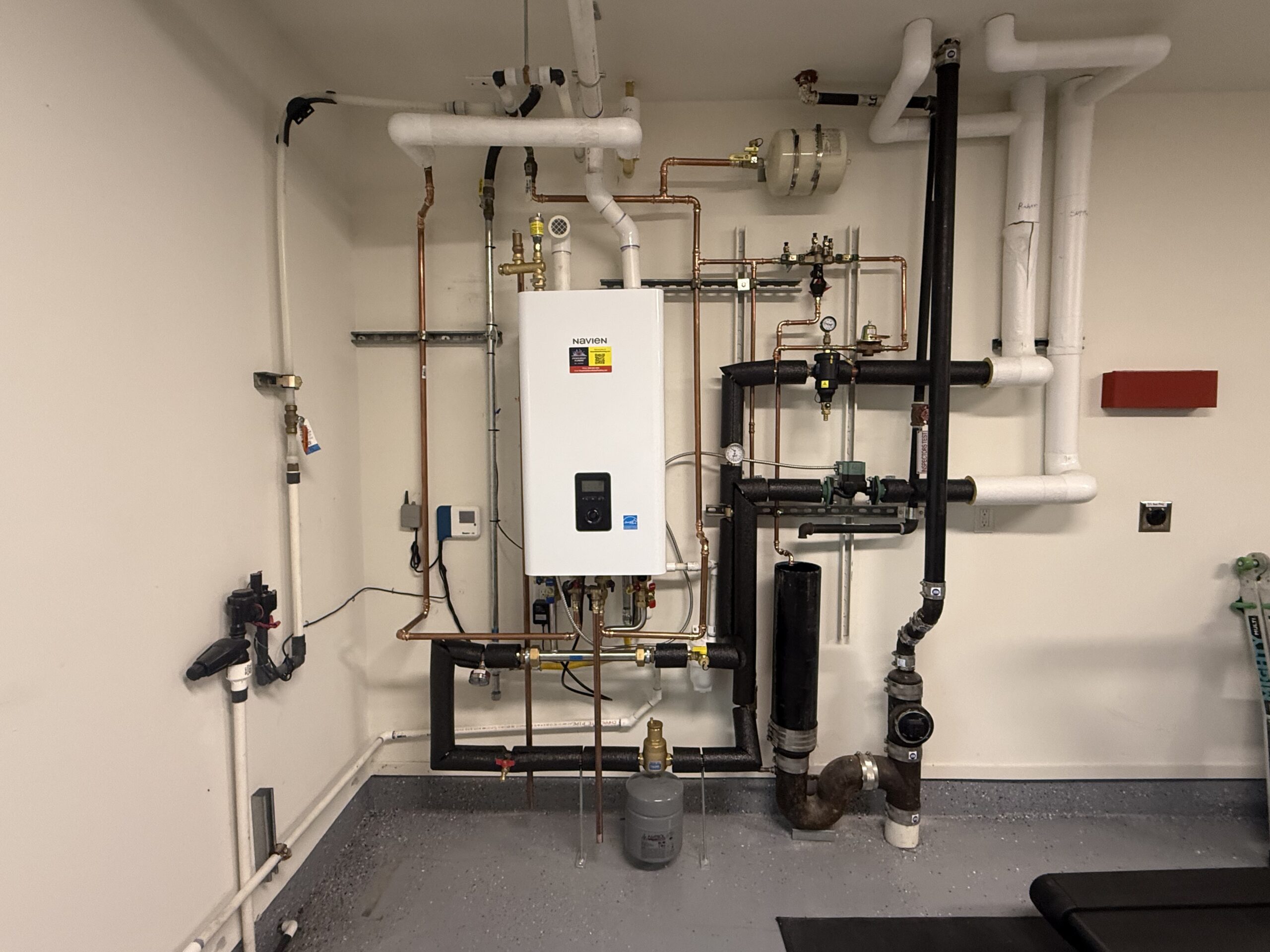
One of the most important aspects of installing a modern combination boiler is the condition and configuration of the hydronic piping. An older boiler may have operated for decades with a piping arrangement that is poorly suited to modern high-efficiency equipment. Existing systems may contain deteriorated valves, improperly located circulators, inadequate air elimination, waterlogged expansion tanks, restricted piping, or circulation configurations that interfere with heating performance. These conditions can remain unresolved when a new boiler is simply connected to the existing piping without a complete evaluation. During a boiler replacement, we assess the mechanical system to determine whether the piping can be reused or whether reconstruction is appropriate. Some projects benefit from a complete replacement of the near-boiler piping, including new copper connections, hydraulic separation, circulation equipment, expansion tanks, isolation valves, and purge assemblies.
Primary and Secondary Circulation
Primary-secondary hydronic piping is designed to allow the boiler and heating distribution system to maintain their respective circulation requirements. This can be achieved through an approved hydraulic separator, closely spaced tees, or another manufacturer-compatible piping configuration. Both Navien NCB-H and NFC-H combination boilers incorporate internal circulation components, but the connected heating distribution system may require additional circulators. Pump selection depends on flow requirements, piping resistance, heating zone configuration, and the boiler manufacturer’s specifications. Proper hydraulic separation helps reduce interference between circulation circuits and allows the system to deliver heat more consistently. It is particularly important when a boiler serves multiple heating zones or a distribution system with different operating requirements.
Expansion Tanks and Pressure Regulation
Closed-loop hydronic systems require properly sized expansion tanks to accommodate the increase in water volume as the heating system reaches operating temperature. An improperly sized or failed expansion tank may cause excessive pressure fluctuations and unwanted pressure relief valve discharge. Expansion tank placement is also important because the connection establishes the system’s point of no pressure change. Circulator positioning relative to this point influences system pressure during operation. A complete installation may also include a pressure-reducing automatic fill valve, backflow prevention assembly, isolation valves, and appropriate safety devices. These components must be selected and installed according to the system’s requirements and applicable plumbing and mechanical codes.
Air Separation and System Purging
Air trapped inside a hydronic heating system can cause noise, inconsistent temperatures, poor circulation, and reduced heating performance. Air may accumulate inside radiators, heating coils, piping high points, and other distribution components. Proper air elimination equipment helps remove entrained air during operation. Accessible purge valves and isolation connections also make initial filling, commissioning, and future maintenance more effective. Hydraulic separators and air separators serve different purposes, although certain multifunction devices incorporate both capabilities. The installation should provide the hydraulic and air elimination functions required by the system.
Our hydronic heating services include diagnosis and replacement of circulation, pressure regulation, and air elimination components.
Connecting a Navien Boiler to Multiple Thermostats and Heating Zones
Many San Francisco and Bay Area properties use multiple thermostats to control separate heating zones. These systems may incorporate motorized zone valves, dedicated zone circulators, switching relays, or electronic zone control panels. When a thermostat calls for heat, the associated controls must activate the correct heating zone and communicate the heating demand to the boiler. Some zone valve systems use end switches that close when a valve opens, creating a common heating demand circuit. Other systems rely on electronic relays or dedicated control panels. Before connecting an existing thermostat circuit to a Navien NCB-H or NFC-H, the wiring arrangement must be identified and verified. A pair of wires that previously operated one boiler should not automatically be assumed compatible with the replacement appliance. We evaluate the heating demand signal, thermostat operation, zone valve response, circulator controls, and electrical compatibility before integrating the existing equipment. This is especially important when replacing older combination boilers connected to multiple zones or unfamiliar control arrangements.
Can a Navien Combination Boiler Supply a Hydronic Air Handler?
Yes. A properly selected Navien combination boiler can supply heated water to a compatible hydronic air handler. These systems use a water-to-air heating coil to transfer heat from circulating boiler water into air distributed through ductwork. Unlike a conventional gas furnace, the air handler does not produce heat through its own combustion process. Instead, heated water from the boiler passes through a coil while a blower distributes warm air throughout the building. Successful integration depends on the air handler’s heating coil capacity, required water temperature, circulation rate, thermostat controls, and overall building heating load. Existing equipment must be evaluated for compatibility before reuse. When an older system produces insufficient heat, the cause may involve the boiler, air handler, circulation pump, zone controls, or a combination of components. Replacing the boiler without diagnosing the connected system may leave the original problem unresolved.
Gas Supply, Combustion Air, and Exhaust Venting
High-efficiency condensing boilers have specific gas supply and venting requirements. Before installation, the existing gas piping must be evaluated for available capacity, connected appliance loads, pressure, and compatibility with the selected boiler. Modern condensing boilers also require approved exhaust venting and combustion air arrangements. Pipe material, diameter, equivalent length, fittings, supports, slope, and exterior termination clearances must comply with the manufacturer’s installation instructions and applicable codes. Existing venting from an older conventional boiler may not be suitable for reuse. Depending on the installation, new vent piping and exterior terminations may be necessary. Condensing appliances also produce condensate that must be properly collected and discharged. A condensate neutralizer may be required or recommended depending on the installation and local requirements.
These considerations are addressed during our professional Navien boiler installation services.
Water Quality and Protecting Your New Boiler
Water quality is an important consideration when installing a modern boiler, especially when connecting new equipment to an older hydronic distribution system. Existing heating circuits may contain sediment, corrosion products, magnetite, and other accumulated debris. If these contaminants are not addressed, they may affect circulators, valves, strainers, and heat-transfer components. Depending on system conditions, preparation may include flushing, cleaning, dirt separation, magnetic filtration, and evaluation of approved hydronic water treatment. Any chemical treatment must be compatible with the boiler manufacturer’s water-quality requirements. We also evaluate conditions that may contribute to continuing corrosion, such as excessive makeup water, oxygen infiltration, or incompatible existing tubing. Protecting the new boiler means considering the entire hydronic system rather than focusing exclusively on the appliance.
What Happens During a Professional Navien Boiler Installation?
A professional boiler installation begins with an assessment of the existing heating equipment and the building’s requirements. This includes evaluating the heating load, domestic hot water demand, piping configuration, circulation equipment, gas supply, electrical connections, venting, and heating controls. Once the appropriate equipment and installation plan are established, the existing boiler and associated piping are removed or modified as required. The new boiler is mounted with appropriate structural support and manufacturer-required service clearances. The hydronic piping is then constructed or reconstructed to incorporate the necessary circulation components, isolation valves, hydraulic separation, expansion tank, pressure regulation, safety devices, and air elimination equipment. Domestic hot water connections, gas piping, combustion air intake, exhaust venting, condensate drainage, and electrical controls are completed according to the approved design. Following installation, the hydronic system is filled and purged. Commissioning includes inspecting for leaks, verifying system pressure, checking circulation, testing thermostat and zone operation, confirming domestic hot water production, and performing applicable combustion and safety checks. A properly commissioned boiler should operate reliably as part of the complete heating system, not simply activate once during the initial startup.
How Condensing Boilers Improve Heating Efficiency
Navien’s NCB-H and NFC-H series use condensing technology to recover additional heat from combustion exhaust gases. By transferring more heat into the heating water, condensing boilers can operate more efficiently than older non-condensing equipment under suitable conditions. The efficiency advantage is particularly relevant when the system operates with lower return-water temperatures. Certain radiant floor heating systems are well suited to these conditions, while higher-temperature radiators or air handlers may require different operating parameters. Proper equipment sizing, circulation, outdoor reset settings where applicable, and temperature control all influence actual operating efficiency. A high-efficiency boiler cannot consistently achieve its potential if it is oversized, short cycles frequently, or operates under unsuitable system conditions.
When Should an Existing Boiler Be Replaced?
Boiler replacement may be appropriate when an appliance experiences repeated failures, significant corrosion, persistent leaks, unavailable replacement parts, or repair costs that are no longer economically justified. Other considerations include inadequate domestic hot water production, inefficient operation, limited serviceability, and renovation projects that change the building’s heating requirements. However, not every heating problem requires a new boiler. Failed circulators, defective zone valves, trapped air, thermostat wiring issues, and expansion tank failures can produce symptoms similar to those of a malfunctioning boiler. Professional diagnosis helps determine whether repairing the existing system or replacing the appliance is the more appropriate investment. Our hydronic heating diagnostics and repair services can help identify these problems.
Maintaining a Navien NCB-H or NFC-H After Installation
Regular maintenance is essential to preserving reliable operation and identifying developing problems. Maintenance may include inspecting system pressure, evaluating the expansion tank, checking circulation equipment, cleaning applicable filters or strainers, examining condensate drainage, assessing combustion-related components, and verifying domestic hot water performance. The domestic hot water and hydronic heating circuits have different maintenance considerations. Potable water mineral content may affect domestic hot water components, while closed-loop heating water quality influences the condition of the hydronic system. Annual professional maintenance is a reasonable starting point for many installations, although specific requirements depend on the equipment, usage, water conditions, and manufacturer’s instructions.
Homeowners interested in maintenance benefits, eligible installation warranty extensions, and service discounts can learn more about our Bailey Priority Plan.
Navien Boiler Installation in San Francisco and the Bay Area
Steven Bailey Plumbing & Rooter provides Navien combination boiler installation, replacement, repair, and maintenance throughout San Francisco, San Mateo County, and Marin County. San Francisco properties feature a wide variety of heating configurations, including older radiator systems, hydronic baseboards, radiant floor heating, and hydronic air handlers. Some systems have been modified repeatedly over the years, making a thorough evaluation of the existing mechanical equipment especially important. We serve neighborhoods including Noe Valley, Russian Hill, Nob Hill, Cow Hollow, the Richmond District, the Sunset District, and surrounding San Francisco communities. Our service area also includes Daly City, South San Francisco, San Bruno, Burlingame, San Mateo, Redwood City, and communities throughout Marin County. Whether the project involves a straightforward boiler replacement or complete hydronic piping reconstruction, our objective is to provide a properly designed installation that supports reliable heating, domestic hot water production, and long-term serviceability.
Frequently Asked Questions About Navien Combi-Boilers
Can a Navien combi-boiler replace both my boiler and water heater?
Yes. In suitable applications, a Navien NCB-H or NFC-H can provide both domestic hot water and hydronic space heating. The building’s heating load, hot water demand, and existing mechanical equipment must be evaluated before recommending the conversion.
What is the difference between the Navien NCB-H and NFC-H?
The NCB-H uses a dual stainless steel space-heating heat exchanger design, while the NFC-H incorporates a stainless steel fire-tube boiler heat exchanger. The NFC-H also offers higher maximum space-heating capacities. The correct choice depends on the property’s heating requirements and installation conditions.
Does a Navien combi-boiler need an expansion tank?
Yes. The closed-loop hydronic heating system requires appropriately sized expansion capacity. The expansion tank accommodates thermal expansion and helps maintain stable system pressure. The tank must be sized and installed according to the system’s requirements.
Does a Navien boiler need an external circulator?
Both the NCB-H and NFC-H incorporate internal circulation components. However, the connected heating distribution system may require an additional circulator or zone circulators depending on the system design, piping configuration, and flow requirements.
Can a Navien boiler operate multiple thermostats and heating zones?
Yes. Navien combination boilers can be integrated with compatible zone valves, circulators, and heating controls. Existing thermostat wiring and control arrangements must be evaluated before connecting them to the new appliance.
Can a Navien combi-boiler heat radiant floors?
Yes. Navien combination boilers can supply appropriately designed radiant floor heating systems. Proper temperature regulation, circulation, zoning, and equipment sizing are essential for reliable performance.
Can a Navien boiler work with a hydronic air handler?
Yes. A properly selected Navien boiler can supply heated water to a compatible hydronic air handler. The air handler’s heating coil, circulation requirements, thermostat controls, and operating temperatures must be evaluated to confirm compatibility.
Is the Navien NFC-H better because it uses a fire-tube heat exchanger?
Not necessarily. Fire-tube construction has particular design characteristics, but the best equipment depends on heating capacity, operating temperatures, installation configuration, service requirements, and the manufacturer’s specifications. A larger boiler is not automatically a better boiler.
How long does a Navien boiler installation take?
Installation time depends on the existing equipment and required modifications. A straightforward replacement may require substantially less work than a project involving complete hydronic piping reconstruction, new venting, gas piping modifications, or multi-zone control integration. An on-site assessment is necessary to establish the scope and schedule.
Do Navien boilers require annual maintenance?
Regular professional maintenance is important for reliable operation. Annual service is a reasonable starting point for many installations, although specific procedures and intervals depend on the manufacturer’s requirements, system conditions, and usage.
Do you provide Navien boiler installation estimates over the phone?
We require an on-site assessment before preparing a complete boiler installation proposal. Equipment sizing, hydronic piping, gas supply, venting, circulation, and heating controls must be evaluated to determine the appropriate installation scope.
Professional Navien Boiler Installation by Steven Bailey Plumbing & Rooter
A new combination boiler is a significant investment in a property’s heating and domestic hot water infrastructure. Choosing a reputable manufacturer is important, but proper installation, piping design, and commissioning are equally essential.
At Steven Bailey Plumbing & Rooter, we evaluate the entire mechanical system when installing Navien equipment. From NCB-H combination boiler installations to NFC-H fire-tube boiler replacements, our services address the equipment and associated hydronic components needed for dependable operation.
We also provide hydronic heating repairs and maintenance and ongoing service through our Bailey Priority Plan.
Steven Bailey Plumbing & Rooter — Expert Plumbing You Can Trust.
Serving San Francisco, San Mateo County, and Marin County.
Steven Bailey Plumbing & Rooter — Expert Plumbing You Can Trust.
Serving San Francisco, San Mateo County, and Marin County.