Shower Repair and Replacement: Prepare Your Bathroom for Fall and Winter While Saving Water and Energy
As fall arrives and temperatures begin to drop, homeowners naturally start thinking about furnaces, water heaters, insulation, and other systems that will see heavier use during the colder months. The shower is easy to overlook, but it is one of the most frequently used plumbing fixtures in the home and a significant consumer of hot water. A dripping showerhead, worn cartridge, malfunctioning pressure-balancing valve, restricted showerhead, or aging shower valve can waste water, make temperature control frustrating, and increase the amount of hot water your household uses. At Steven Bailey Plumbing & Rooter, we provide professional shower repair, shower cartridge replacement, shower valve repair, fixture replacement, and plumbing diagnostics throughout San Francisco, Marin County, and San Mateo County. Whether your shower will not stop dripping, has weak water flow, suddenly changes temperature, is difficult to operate, or simply needs to be modernized, addressing the problem before the colder months can improve comfort while helping reduce unnecessary water and energy consumption.
Why Fall Is a Good Time to Have Your Shower Inspected
A shower may technically continue working for years while gradually developing problems. The handle becomes harder to turn. The temperature has to be adjusted more carefully. A small drip develops after the valve is shut off. Hot water takes longer to reach the shower. The showerhead does not seem to have the pressure it once had. Because these changes often happen slowly, homeowners can become accustomed to them instead of recognizing them as signs that the fixture needs attention. Fall is an excellent time to address these problems because hot-water demand generally becomes more noticeable during colder weather. Incoming water is colder, people often take warmer or longer showers, and the water heater has to provide a greater temperature rise to produce comfortable hot water. Reducing unnecessary hot-water use can therefore help reduce both water consumption and the energy required to heat that water. A properly functioning shower should turn on and off reliably, maintain a reasonably consistent selected temperature, deliver appropriate flow, and operate without continuous dripping or leakage. If it does not, the underlying problem should be diagnosed rather than assuming that the entire shower valve automatically needs replacement.
Dripping Shower? The Cartridge May Be the Problem
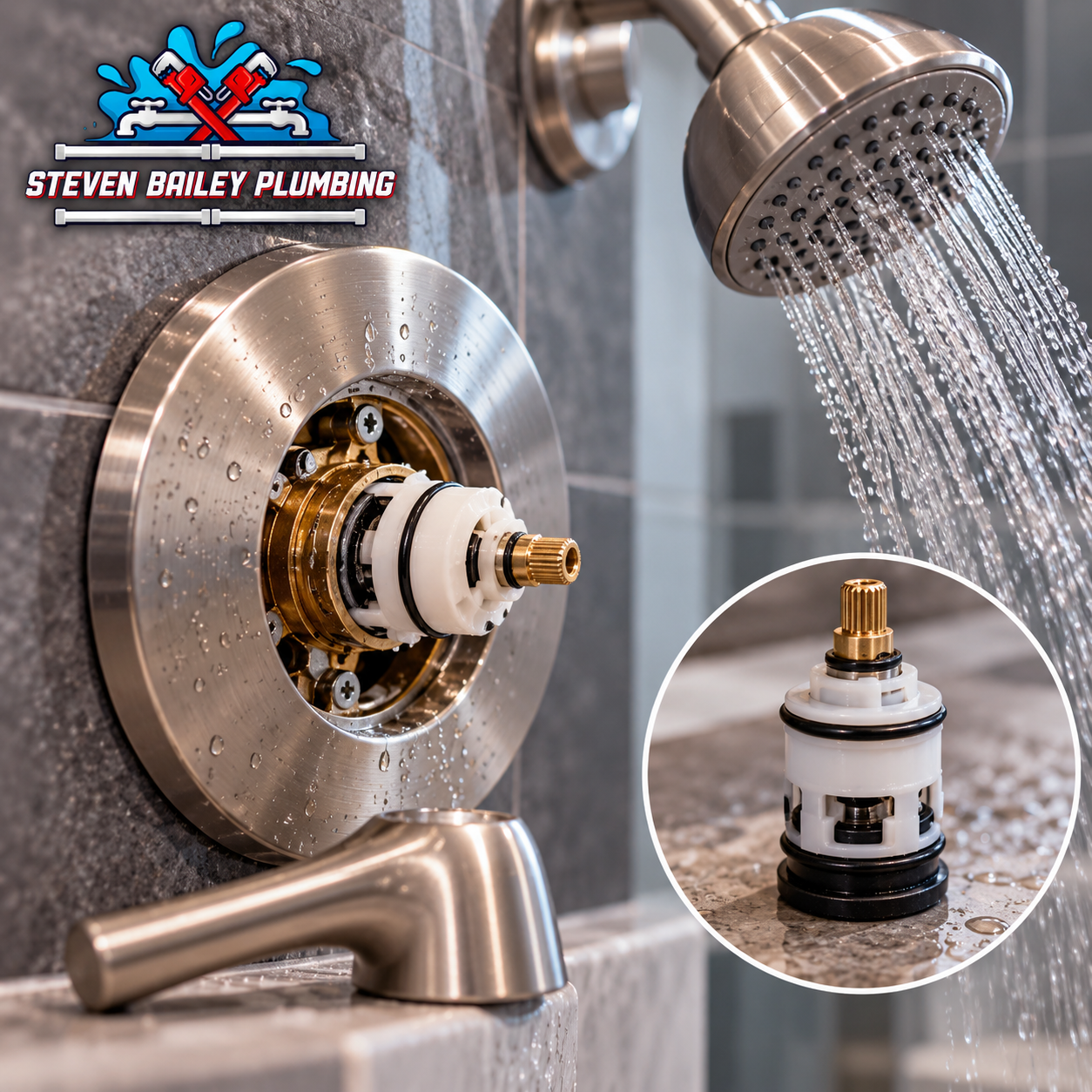
One of the most common shower repairs is shower cartridge replacement. The cartridge is an internal component of many modern shower valves that helps control water flow and, depending on the valve design, the mixture of hot and cold water. Every time the shower is operated, components within the cartridge move and seal against water pressure.Eventually, seals can deteriorate, internal surfaces can wear, and mineral deposits or debris can interfere with operation. A common symptom is a showerhead that continues dripping even though the handle is completely in the OFF position. Depending on the valve, a failing cartridge can also contribute to a stiff or difficult-to-operate handle, improper shutoff, inconsistent flow, or problems controlling temperature. Replacing the cartridge can often restore proper operation without replacing the complete valve body behind the wall. The correct repair, however, depends on what has actually failed. A dripping shower can also result from damaged valve components, deteriorated seats or seals, pressure-related issues, or other conditions. Professional diagnosis is especially valuable when the manufacturer or model is unknown or when an older valve has already been repaired several times.
Inconsistent Shower Temperature Should Not Be Ignored
A shower that suddenly becomes hotter or colder can be more than an inconvenience. Modern shower valves commonly incorporate pressure-balancing or thermostatic technology intended to help control temperature fluctuations. If the cartridge or balancing mechanism becomes worn, restricted, or damaged, the valve may not respond as intended. Temperature problems are not always caused by the shower valve itself. Water-heater performance, crossover between hot and cold piping, recirculation-system problems, pressure differences, partially closed valves, plumbing restrictions, and simultaneous fixture use can all influence what happens at the shower. This is why replacing parts without diagnosing the system can become expensive. If a new cartridge does not address the underlying cause, the homeowner has paid for a repair without solving the problem. A professional shower diagnosis should determine whether the issue originates at the fixture, within the piping system, or at the water heater before recommending a larger repair.
Low Shower Flow: Cartridge, Showerhead, or Plumbing Problem?
Low shower flow is another common complaint, particularly in older homes. Mineral deposits can accumulate inside showerheads and small internal passages. Cartridges can become restricted by debris. Older galvanized piping can develop significant internal corrosion. Pressure-reducing valves and other plumbing components can affect available pressure throughout the house. It is also important to distinguish water pressure from water flow. A shower that feels weak does not automatically mean the entire building has low water pressure. If every other fixture performs normally, the restriction may be isolated to the showerhead, cartridge, valve, or branch serving that fixture. If several fixtures have deteriorated at the same time, the investigation should expand to the home’s water-supply system. Before replacing an entire shower valve, the existing fixture should be evaluated to determine whether a more targeted repair makes sense. A cartridge replacement, showerhead service, or correction of another localized restriction can be substantially less invasive than opening a wall to replace a valve that is otherwise serviceable.
Showerhead Replacement Can Reduce Water and Energy Use
The shower is a major source of residential indoor water consumption. Replacing an older or inefficient showerhead can reduce water use every time the shower is operated. Because a significant portion of shower water is heated, reducing unnecessary shower flow can also reduce the amount of energy used by the home’s water-heating system. For California homeowners, fixture selection also needs to account for California water-efficiency requirements. That does not necessarily mean accepting an unpleasant shower. Modern high-efficiency showerheads are designed around spray pattern, coverage, and velocity as well as raw gallons per minute. Choosing a quality fixture can therefore provide satisfying performance while reducing unnecessary water consumption. If you are already planning a larger bathroom remodeling project, it can also be an appropriate time to evaluate the shower valve, trim, showerhead, tub spout, piping, and hot-water requirements as one complete system rather than replacing components individually over several years.
A Small Drip Can Become a Long-Term Expense
A homeowner may tolerate a dripping shower because the amount of water lost each minute seems insignificant. The problem is that plumbing fixtures operate every day, and small losses accumulate over weeks, months, and years. Water that continuously passes through a leaking fixture serves no useful purpose but still appears on the water bill. If the leak involves hot water or causes a water heater or recirculation system to operate more than necessary, there can also be an energy component to the waste. Repairing leaks is one of the simplest ways to improve the efficiency of an existing plumbing system because the objective is not to change how the homeowner uses the fixture. It is simply to stop paying for water and energy that are being wasted. A persistent drip can also be an indication that internal valve components are deteriorating. Addressing the problem when it is still a straightforward cartridge or valve repair may help prevent additional wear and make it easier to keep the existing fixture in service.
Repair the Existing Shower or Replace the Valve?
Not every shower problem requires complete replacement. If the valve body is in good condition and replacement components remain available, cartridge replacement or internal valve repair can often extend the service life of the existing fixture. Complete shower valve replacement becomes more attractive when the valve is obsolete, replacement components are unavailable, the valve body itself is damaged, there is significant corrosion, repeated cartridge replacements have not provided reliable service, or the homeowner wants to modernize the shower during a bathroom renovation. There is also an important difference between replacing decorative trim and replacing the actual rough-in valve. Handles, escutcheons, showerheads, and other visible components may sometimes be updated while retaining the existing valve body, but compatibility depends heavily on the manufacturer and valve platform. Plumbing trim is generally not universally interchangeable. For homeowners planning a bathroom remodel, replacing an old or questionable valve while the wall is already open can make considerably more sense than installing new tile around an aging valve and later having to gain access again. The objective should be long-term serviceability, not simply making the fixture look new.
Shower Valve Replacement During a Bathroom Remodel
A bathroom remodel provides an opportunity to address plumbing components that may otherwise remain concealed for decades. If walls are already being opened for tile, waterproofing, fixture relocation, or other construction, the condition and age of the existing shower valve should be considered before the new finished surfaces are installed. Proper rough-in depth is especially important. Shower valves, trim plates, handles, tub spouts, and other components have specific installation requirements based on the finished wall thickness. A valve installed too deep or too shallow can create problems when the final trim is installed. Planning these details before tile installation can produce a cleaner finished appearance and improve future serviceability. If a shower valve is being replaced as part of a larger renovation, proper rough-in depth, valve positioning, fixture compatibility, and final trim installation are especially important. Our finish plumbing services can include shower trim, handles, showerheads, tub spouts, faucets, toilets, and other final plumbing fixtures included in the project scope.
Older San Francisco and Bay Area Homes Require a Different Approach
Shower repair in San Francisco and surrounding Bay Area communities can present challenges that are less common in newer construction. Older homes may have undergone several generations of plumbing alterations, leaving a mixture of original piping, later renovations, discontinued valves, unusual access conditions, and repairs performed decades apart. A shower that appears straightforward from the finished side of the wall may have galvanized steel, copper, PEX, brass adapters, or multiple generations of fittings behind it. In some properties, there may be no practical rear access to the valve because another tiled bathroom, cabinet, hallway, or finished room sits directly behind the shower. That is why we place an emphasis on diagnosis before demolition. If a cartridge or serviceable component can solve the problem reliably, there may be no reason to disturb finished tile. When complete valve replacement is appropriate, access and restoration requirements should be considered before the work begins.
Don’t Forget the Tub Spout and Diverter
In a combination bathtub and shower, the shower valve is only part of the system. The tub spout and diverter also affect performance. A worn diverter can allow a significant amount of water to continue flowing from the tub spout while the shower is operating, reducing the amount of water reaching the showerhead. If water continues flowing heavily from the tub spout when the diverter is engaged, the diverter or tub spout may need repair or replacement. Correcting the diverter can improve shower performance without increasing the home’s water pressure or replacing the shower valve itself. During a complete shower or bathroom upgrade, the tub spout, showerhead, valve trim, handles, and other visible components can also be evaluated together so the finished installation operates and appears as a coordinated system.
Fall and Winter Plumbing Efficiency Starts With the Whole Hot-Water System
A shower does not operate independently from the rest of the plumbing system. If you are preparing your home for fall and winter, shower performance should be considered alongside the water heater, hot-water piping, recirculation system, pressure regulation, and other fixtures. A shower that takes several minutes to become hot wastes both water and time while the occupant waits. Depending on the home, excessive hot-water delivery time may result from the distance between the water heater and fixture, piping layout, recirculation-system operation, or other design factors. In larger homes, a properly designed and controlled hot-water recirculation system can improve convenience and reduce the amount of potable water sent down the drain while waiting for hot water. However, recirculation should be designed correctly. Improper check-valve placement, failed pumps, crossover conditions, incorrect controls, and poorly balanced systems can create their own temperature problems. If a shower’s temperature changes after work has been performed on a water heater or recirculation system, the entire hot-water distribution system may need to be evaluated rather than concentrating exclusively on the shower cartridge.
When Should You Call a Plumber for Shower Repair?
A shower should be inspected when it continues dripping after being shut off, becomes difficult to turn on or off, produces noticeably reduced flow, cannot maintain a comfortable temperature, develops leakage around the handle or trim, makes unusual noises, or stops properly diverting water between the tub spout and showerhead. Water appearing outside the shower enclosure, inside an adjacent wall, on a ceiling below the bathroom, or around plumbing penetrations deserves more immediate attention. The visible location of water does not always identify its source. Shower pans, waterproofing, drains, supply piping, valves, tub spouts, caulking, and enclosures can produce leaks that appear similar from the finished side. If water is actively leaking into a wall, ceiling, floor, or another area of the property, the problem should be addressed promptly. Learn more about our emergency plumbing services for serious plumbing leaks, burst piping, concealed leaks, and other urgent plumbing failures.
Can Shower Repairs Help Save Money?
Shower repair is not only about comfort. Correcting a leaking cartridge, inefficient showerhead, failed diverter, hot-water delivery problem, or other malfunction can reduce unnecessary operating costs over time. The greatest opportunities generally come from eliminating water that is being wasted and reducing unnecessary hot-water consumption. A repair can also save money when it allows an otherwise serviceable shower valve to remain in operation. Replacing a cartridge is typically a much more focused project than opening a finished wall, removing the existing valve body, modifying piping, installing a new valve, and dealing with access or finish restoration. This is why an accurate diagnosis matters. The most expensive repair is not automatically the best repair. At the same time, repeatedly investing in an obsolete or badly deteriorated valve may eventually stop making financial sense. When replacement components become difficult to obtain or the valve body itself is compromised, replacement can provide a better long-term solution. We prefer to evaluate the condition of the system and explain the available options rather than automatically recommending replacement.
Financing for Qualifying Plumbing and Bathroom Projects
A cartridge replacement or basic shower repair may be relatively straightforward, but some shower problems reveal larger plumbing needs. An older bathroom may require a complete valve replacement, deteriorated piping may be discovered behind the wall, or a homeowner may decide that it makes more sense to complete a larger bathroom renovation while the plumbing is accessible. For qualifying larger projects, Steven Bailey Plumbing & Rooter offers plumbing financing options through Wisetack. Eligible customers may be able to explore payment options for qualifying plumbing repairs, water-heating equipment, bathroom plumbing improvements, piping work, and other eligible projects. Financing is subject to approval and individual terms.
Professional Shower Repair in San Francisco, Marin County, and San Mateo County
Steven Bailey Plumbing & Rooter provides professional shower repair, shower cartridge replacement, shower valve repair, showerhead replacement, plumbing leak diagnosis, water-pressure troubleshooting, and bathroom plumbing services throughout San Francisco, Marin County, and San Mateo County. Whether you have a persistent drip, inconsistent water temperature, weak shower flow, an aging valve, or a shower that simply no longer performs the way it should, we can evaluate the system and recommend an appropriate repair or replacement. When replacement is justified, we can also help evaluate modern fixtures with consideration for reliability, serviceability, water efficiency, performance, and compatibility with the existing plumbing system. Preparing for fall and winter does not always require a major plumbing project. Sometimes it means repairing the fixtures you already use every day, eliminating unnecessary water waste, improving hot-water performance, and correcting small problems before they become larger and more expensive problems.
Steven Bailey Plumbing & Rooter — Expert Plumbing You Can Trust.